Singapore's built environment sector — construction, facilities management, architecture, engineering — represents over $30 billion in annual output. It employs hundreds of thousands of workers and shapes the physical infrastructure of one of the world's most advanced economies. Yet according to McKinsey, construction remains one of the least digitised industries globally, with productivity growth averaging just 1% annually over the past two decades.
That's starting to change. A new generation of AI — not chatbots, not dashboards, but autonomous AI agents — is beginning to address the specific challenges that have made construction resistant to previous waves of technology adoption. This guide explores what's different this time, what's working in Singapore, and how firms in the built environment can get started.
Singapore's Built Environment Is Ready for AI
Several forces are converging to make 2026 a turning point for AI in Singapore's construction sector:
- Government commitment: The S$30 million Built Environment AI Centre, announced in partnership with BCA and industry stakeholders, is specifically designed to accelerate AI research and deployment for construction. The Budget 2026 announcements further reinforced this with expanded grants for SME technology adoption.
- Industry recognition: A 2025 industry survey found that 98% of construction firms in Singapore consider AI important for their future competitiveness. The gap between recognising importance and actual adoption represents an enormous opportunity for early movers.
- Labour constraints: Singapore's construction workforce faces structural challenges — an ageing workforce, tightening foreign labour policies, and increasing project complexity. AI doesn't replace workers; it amplifies their capacity by handling administrative burden.
- Data availability: Unlike a decade ago, construction sites today generate massive data streams — thousands of photos, hundreds of WhatsApp messages, digital inspection records, and IoT sensor readings — every single day. The raw material for AI is already there.
The question is no longer whether AI will transform the built environment. It's which firms will move first and capture the competitive advantage.
Why Chatbots Failed Construction — And What AI Agents Do Differently
Many construction professionals have tried AI tools and walked away unimpressed. The typical experience: someone introduces a chatbot or AI assistant, a few people try it for a week, and then it's forgotten. This isn't because AI doesn't work — it's because the wrong type of AI was applied to construction's unique operating environment.
Understanding the difference between chatbots and AI agents is critical:
| Chatbots / Copilots | AI Agents | |
|---|---|---|
| Who initiates? | The user must type a prompt | The agent monitors data streams and acts autonomously |
| Data entry | Manual — user must input information | Automatic — reads from existing sources (WhatsApp, photos, sensors) |
| Adoption requirement | Everyone must learn the new tool | Zero behaviour change — teams keep using WhatsApp and cameras |
| Failure mode | People stop using it after novelty wears off | Runs in background — adoption isn't a factor |
| Output | Answers to questions you think to ask | Proactive alerts, reports, and insights you didn't know to ask for |
| Construction fit | Poor — site teams don't sit at desks typing prompts | Strong — works with the communication patterns sites already use |
The fundamental problem with chatbots in construction is simple: site teams don't have time to type prompts. A site supervisor managing 50 workers across three zones doesn't stop to ask an AI assistant for help. They're sending rapid-fire WhatsApp messages, taking photos on the move, and dealing with real-time problems.
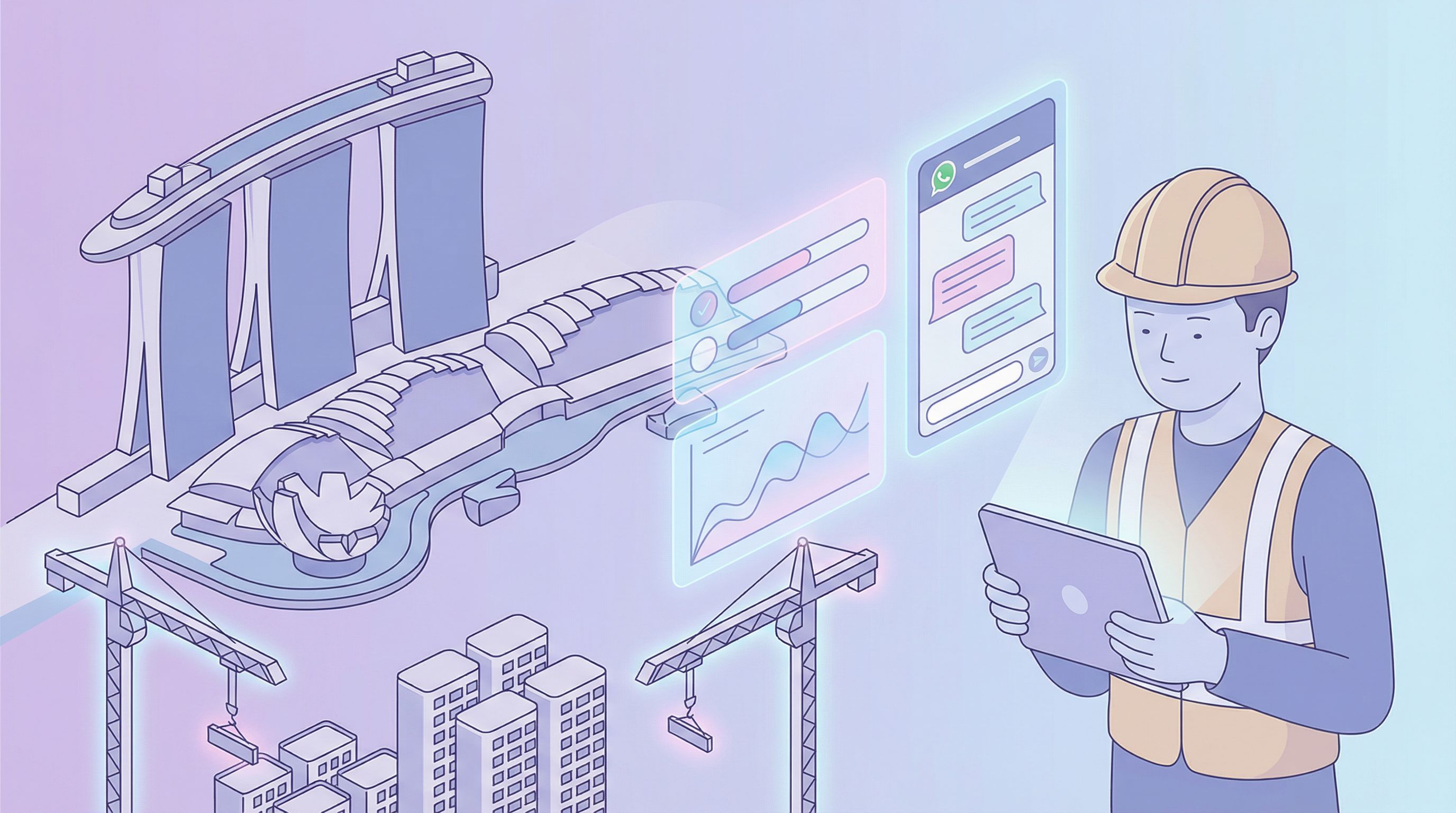
AI agents flip this model entirely. Instead of waiting for input, they monitor the data streams that already exist — WhatsApp groups, photo feeds, sensor data — and extract actionable intelligence without requiring anyone to change their behaviour.
Five Practical AI Applications for Construction in Singapore
Here are five applications that are delivering measurable results on Singapore construction projects today:
1. Automated Progress Tracking from Site Photos
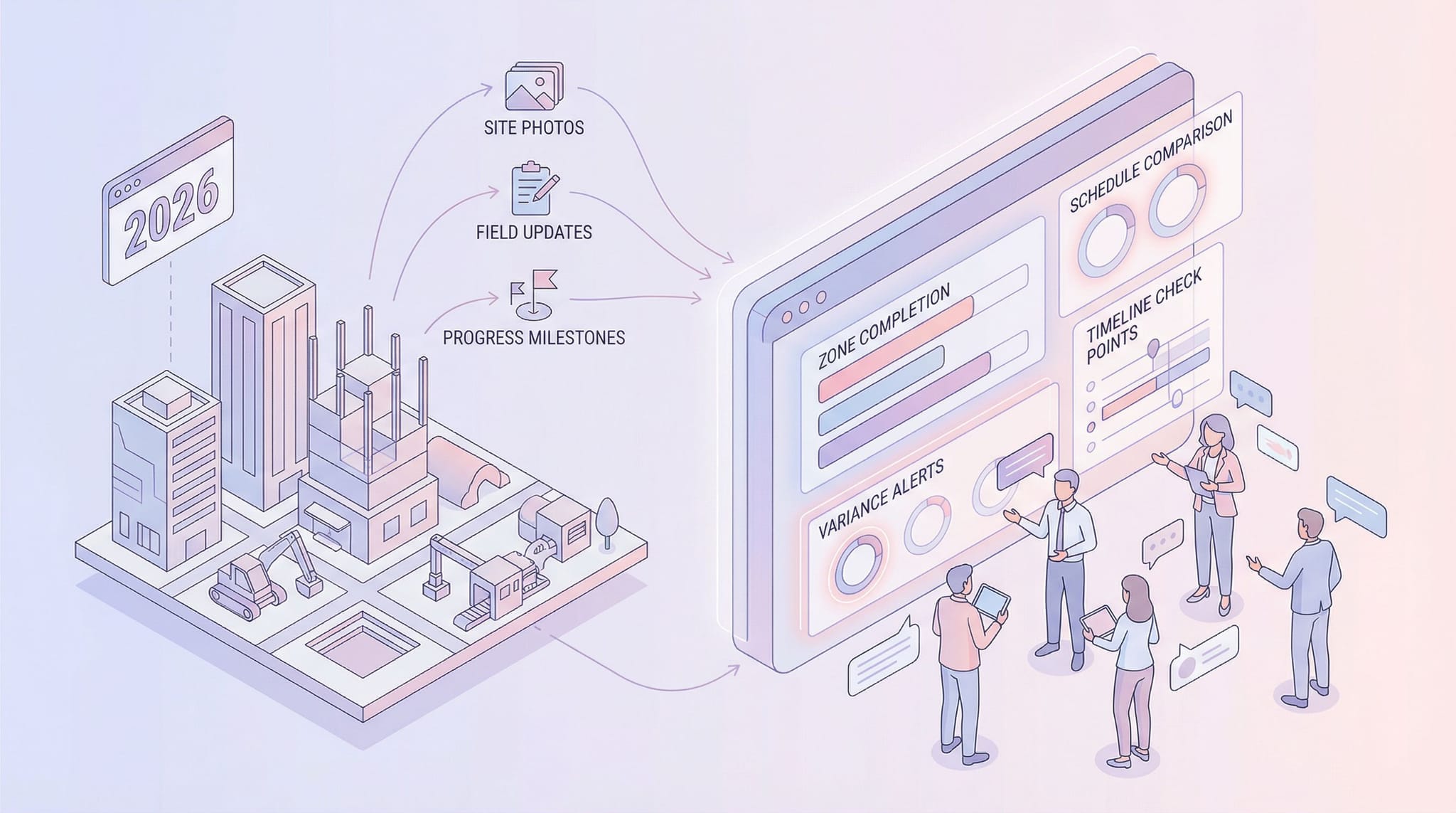
Site teams take hundreds of photos daily. AI computer vision can analyse these photos to automatically assess construction progress — identifying completed activities, estimating percentage completion, and comparing actual progress against the baseline schedule.
2. Real-Time Safety Violation Detection
AI agents can monitor site photo feeds and flag potential safety violations as they appear — missing PPE, unsafe scaffolding configurations, housekeeping issues, exclusion zone breaches.
3. QA/QC Defect Documentation
Defect management in construction is notoriously fragmented. AI can consolidate defect observations from multiple sources into a unified, searchable database. Each defect is automatically tagged with location, trade, severity, and status.
4. Daily Report Generation from WhatsApp
AI agents monitor project WhatsApp groups, extract relevant information, and generate structured daily reports automatically. Site managers who spent 60–90 minutes writing reports each evening get that time back immediately.
5. Schedule Variance Early Warning
By continuously comparing actual progress data against the project schedule, AI can identify emerging delays before they become critical.
Why Construction Needs Domain-Specific AI
A common question is: "Why can't we just use ChatGPT or a general AI tool?" The answer lies in the specific demands of construction data:
- Construction terminology is specialised: When a site supervisor messages "L3 RC 50% — rebar done, pour tmr pending RO", a general AI model has no idea what this means. A construction-trained AI understands this as: Level 3 reinforced concrete is 50% complete, reinforcement is finished, concrete pour is scheduled for tomorrow pending Resident Officer approval.
- Regulatory context matters: Singapore's construction industry operates under specific BCA codes, WSH regulations, and contractual frameworks. AI that generates safety documentation needs to understand these frameworks.
- Multilingual, informal communication: Site communication in Singapore happens in a mix of English, Mandarin, Malay, Tamil, and Singlish — often within the same message.
- Visual understanding of construction: Identifying that a photo shows "Level 4 formwork in progress" versus "Level 4 rebar installation" requires visual models trained specifically on construction imagery.
Getting Started: It's Simpler Than You Think
- No hardware required: AI agents run in the cloud. Your site teams use the phones and cameras they already have.
- No app downloads: The AI connects to WhatsApp and processes photos from existing channels.
- No behaviour change: Your teams keep sending messages and taking photos exactly as they do today.
- No long implementation: Typical setup takes days, not months.
Singapore's built environment is at an inflection point. The firms that adopt AI now — while the technology is new and government support is at its peak — will set the standard for how construction projects are managed in the years ahead.
Start your AI journey with Wenti Labs — or see how other Singapore construction firms are already using AI agents in our case studies.