When generative AI burst onto the scene in late 2022, the construction industry was told it would revolutionise everything — from project planning to safety management. Three years later, construction remains one of the lowest AI adopters across all major industries. But the reason isn't that AI doesn't work. It's that generic AI tools were never built for how construction actually operates.
This isn't a story about technology failing. It's a story about misaligned implementation — and what the industry has learned since.
The Promise Was Real — The Implementation Wasn't
The core capabilities of large language models are genuinely impressive. They can parse unstructured text, summarise documents, answer complex questions, and even analyse images. These are exactly the kinds of tasks that consume hours of construction professionals' time every week.
But between the promise and the reality sat a gap that most technology vendors ignored: construction sites are not Silicon Valley offices. The workflows are different. The stakes are different. The tolerance for error is fundamentally different.
According to a 2024 McKinsey survey, fewer than 15% of construction firms had implemented any form of generative AI in their operations — compared to over 60% in financial services and technology. The question was never whether AI could help construction. It was whether the available tools were fit for purpose.
Why Generic AI Fails on Construction Sites
Having worked with construction teams across Singapore and the region, we've identified four specific failure modes that explain why off-the-shelf AI tools consistently underdeliver in this industry.
1. Hallucination Is Dangerous When Safety Is Involved
In most industries, an AI that's "mostly right" is still useful. In construction, "mostly right" can be dangerous. Consider a project manager asking an AI chatbot about workplace safety requirements. A generic LLM might confidently cite a non-existent clause in the Workplace Safety and Health Act, or misstate a Building and Construction Authority (BCA) code requirement. It will do so with complete confidence, offering no indication that the information is fabricated.
In a boardroom, a hallucinated statistic is embarrassing. On a construction site, a hallucinated safety requirement — or a missed one — creates real liability. Construction professionals are right to be sceptical of tools that can't distinguish between what they know and what they're inventing.
2. Data Privacy Matters When Projects Are Confidential
Construction projects involve highly sensitive information: tender pricing, proprietary construction methods, client drawings, contractual terms, and project financials. When teams use generic AI tools like ChatGPT or Google's Gemini, they risk exposing this data to models that may use inputs for training purposes.
For a main contractor handling a government project, or a developer with proprietary design specifications, this isn't a theoretical concern — it's a contractual and legal risk. Many construction contracts explicitly prohibit sharing project information with third-party platforms.
3. Integration Fails When Your System Is WhatsApp + Excel
Enterprise AI solutions are typically designed to integrate with CRM systems, ERP platforms, and structured databases. Construction's reality is different. Project communication happens on WhatsApp. Progress tracking lives in Excel spreadsheets. Drawings are shared as PDFs on messaging groups. Daily reports are written in notebooks or typed into phones.
An AI tool that requires a clean API connection to a centralised database is solving a problem construction doesn't have — while ignoring the messy, fragmented data environment where the real work happens.
4. Adoption Requires Zero Behaviour Change
A 2024 Deloitte study on construction technology adoption found that workflow disruption is the single biggest barrier to technology uptake — ahead of cost, ahead of technical complexity. If a tool requires site teams to open a separate application, type structured prompts, and wait for responses, adoption will be near zero.
Site supervisors, foremen, and project engineers are already stretched thin. They communicate in shorthand on WhatsApp because it's fast. Any AI solution that adds steps to their workflow, rather than removing them, is dead on arrival — regardless of how powerful the underlying technology is.
What Has Changed Since 2023
The good news is that the AI landscape has matured significantly. Several developments have closed the gap between generic AI capabilities and construction-specific requirements:
- Domain-specific fine-tuning: Models can now be trained on construction-specific terminology, codes, and workflows, dramatically reducing hallucination in specialised contexts.
- Retrieval-Augmented Generation (RAG): Rather than relying on an LLM's general knowledge, RAG architectures ground every AI response in actual project data — your drawings, your specifications, your site records. The AI answers based on what it can retrieve, not what it imagines.
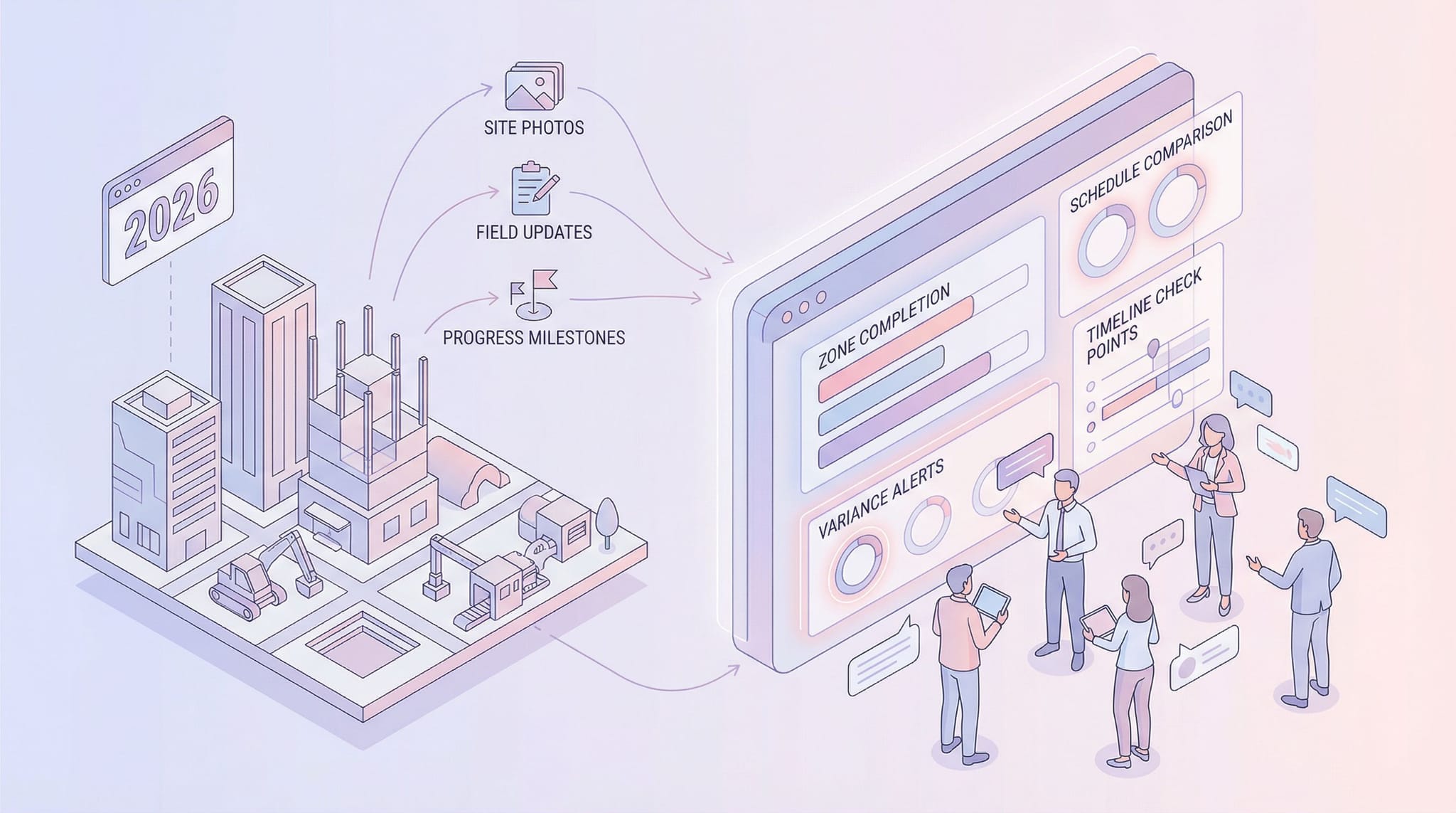
- Multimodal AI: Modern models can process site photos, identifying completed work, detecting safety violations, and verifying quality — turning the thousands of photos taken daily on construction sites into structured, actionable data.
- AI agents that monitor rather than chat: Instead of waiting for users to ask questions, agentic AI systems can continuously monitor project communication, flag issues proactively, and deliver insights through existing channels like WhatsApp.
These aren't incremental improvements. They represent a fundamental shift from "AI as a chatbot" to "AI as an integrated, context-aware project tool."
What Actually Works in Construction
Based on real deployments across construction sites in Singapore, we've found that AI adoption succeeds when the technology follows four principles:
- Process photos rather than generate text. Construction is a visual industry. AI that can look at a site photo and identify what work has been completed, what safety equipment is missing, or what quality issues are present delivers immediate, tangible value — without requiring anyone to type a prompt. Learn more about AI-powered safety monitoring.
- Monitor existing communication rather than require new tools. The data is already flowing through WhatsApp groups. AI that reads and structures this existing communication — rather than asking teams to switch platforms — achieves adoption because it demands nothing from end users.
- Deliver through familiar channels rather than separate dashboards. When AI insights arrive as a WhatsApp message or an automated email summary, they get read. When they sit in a dashboard that requires a login, they don't. Meeting people where they already work is not a UX preference — it's an adoption requirement.
- Ground every response in actual project data rather than general knowledge. RAG-based systems that retrieve information from your BIM models, your specifications, and your site records eliminate the hallucination problem. The AI doesn't guess — it looks up the answer in your project data and cites its source.
This approach — which we call agentic AI — is fundamentally different from giving construction teams a chatbot and hoping they use it. It's AI that works in the background, integrated into existing workflows, delivering value without demanding behaviour change.
The Scepticism Was Warranted — But the Landscape Has Shifted
Construction professionals who dismissed the first wave of AI hype were right to do so. Generic tools weren't ready for the complexity, sensitivity, and practical constraints of construction projects. That scepticism was — and remains — a sign of professional rigour.
But the tools have evolved. Domain-specific, RAG-grounded, multimodal AI systems that work within construction's existing workflows rather than against them are now delivering measurable results on real projects.
The question is no longer whether AI can work in construction. It's whether your organisation is evaluating the right kind of AI — or still judging the industry by chatbots that were never designed for it.
See how construction-specific AI is working on real projects. Explore our case studies or get started with a pilot.