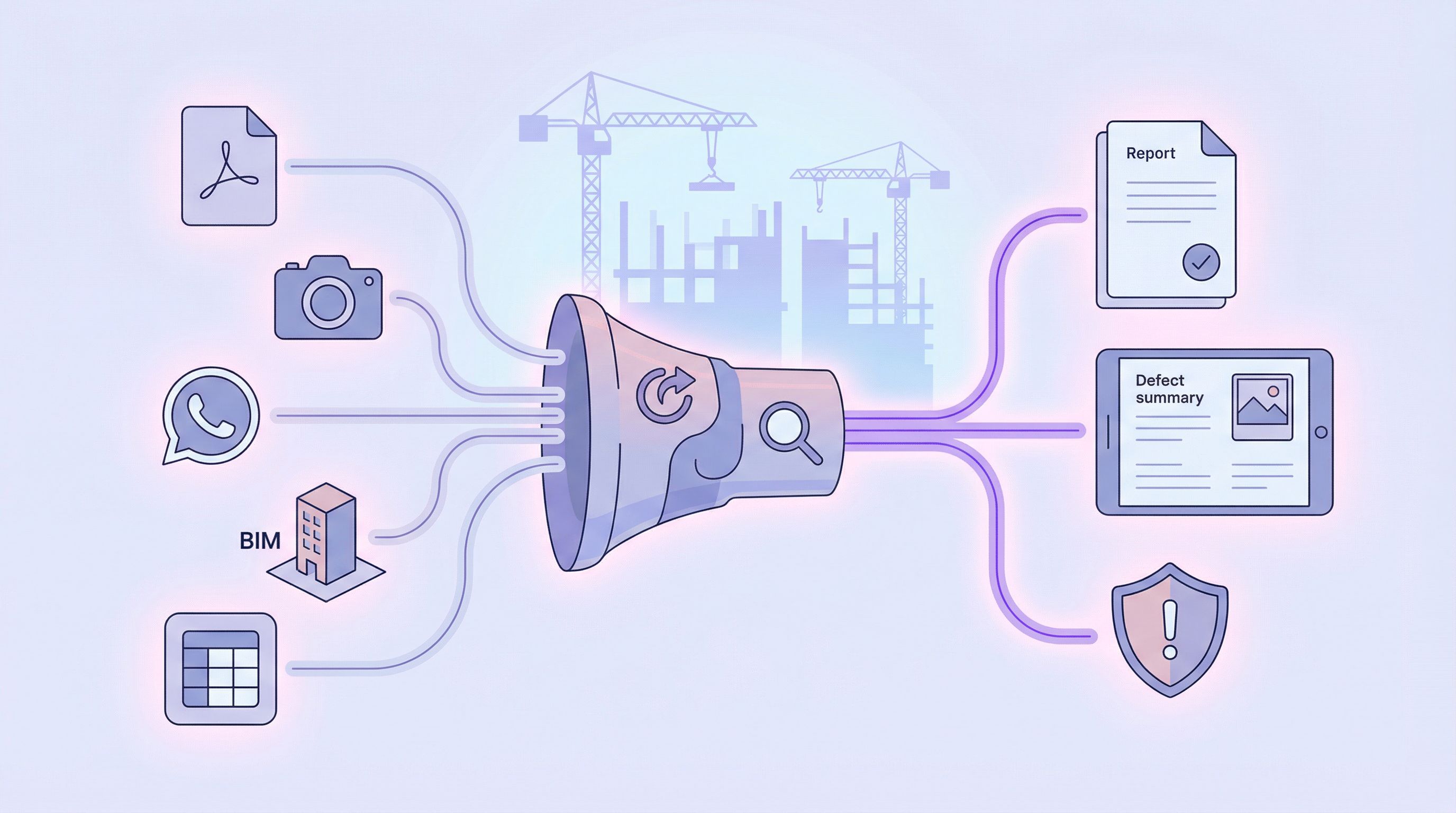
If you've used ChatGPT, asked Siri a question, or received an AI-generated email summary, you've interacted with a Large Language Model. LLMs are the technology behind the current wave of AI tools — and increasingly, they're the engine powering AI systems purpose-built for construction.
This guide explains what LLMs are, how they're being used in construction, and what their limitations mean for your projects — without the jargon.
What Is a Large Language Model?
A Large Language Model is an AI system trained on vast amounts of text data — books, websites, technical documents, code — to understand and generate human language. "Large" refers to the scale: modern LLMs have hundreds of billions of parameters (the internal settings the model learns during training) and have processed trillions of words.
The result is a system that can read text, understand meaning, follow instructions, and produce coherent responses across virtually any topic.
Here's a construction analogy: if an AI agent is like a site manager — coordinating tasks, processing information, and making decisions — the LLM is the brain. It's the component that understands what a foreman's message means, interprets a specification clause, or recognises what's in a site photo. The AI agent provides the tools, the memory, and the connections to your project data. The LLM provides the reasoning.
How LLMs Are Used in Construction
The practical value of LLMs in construction comes from their ability to handle unstructured, messy, real-world communication — exactly the kind of data that construction generates every day.
Parsing Unstructured Site Messages
A foreman sends a WhatsApp message: "L3 RC 50% done, rebar inspection tmr, short 2 workers". A human project manager understands this instantly. A traditional software system sees meaningless text. An LLM can parse this into structured data: Location: Level 3. Activity: Reinforced Concrete works. Progress: 50%. Upcoming: Rebar inspection scheduled tomorrow. Issue: Labour shortfall of 2 workers.
This capability — turning natural language into structured records — is what enables AI-powered progress tracking without requiring site teams to fill in forms or use specialised apps.
Processing Multilingual Communication
Singapore construction sites are multilingual environments. A single WhatsApp group might contain messages in English, Mandarin, Malay, and Tamil — sometimes mixed within the same message. LLMs handle this naturally, understanding meaning across languages without requiring separate translation steps.
Generating Daily Progress Summaries
From dozens of fragmented WhatsApp messages, an LLM can produce a coherent daily progress report — organised by zone, trade, or activity — in seconds. What previously required a project engineer to spend 30 to 60 minutes compiling manually can be automated without losing accuracy or context.
Answering Project Queries
When connected to project data through a RAG (Retrieval-Augmented Generation) architecture, an LLM can answer specific questions: "What's the status of Block A Level 3?" or "When was the last concrete pour for Zone 2?" — pulling answers from actual site records rather than general knowledge.
Extracting Requirements from Specifications
Construction specifications are dense, lengthy documents. LLMs can extract key requirements, flag potential conflicts between clauses, and summarise relevant sections — reducing the time spent manually reviewing hundreds of pages.
Multimodal LLMs: When AI Can See Your Site Photos
The latest generation of LLMs — including GPT-4o, Claude, and Gemini — are multimodal, meaning they can process both text and images. For construction, this is a significant capability.
Multimodal LLMs can analyse site photos to:
- Identify completed work: Recognising that formwork has been erected, rebar has been placed, or concrete has been poured — and matching this against planned activities.
- Detect safety violations: Spotting missing personal protective equipment (PPE), absent guardrails, improper scaffolding, or housekeeping issues from routine site photos. Learn more about AI-powered safety monitoring on construction sites.
- Verify quality: Identifying potential defects such as concrete honeycombing, misaligned formwork, or rebar spacing issues that might otherwise require close physical inspection.
Construction sites already generate thousands of photos daily. Multimodal LLMs turn these photos from passive records into active data sources — extracting information that would otherwise require manual review.
LLM Limitations Construction Teams Should Know
LLMs are powerful, but they have specific limitations that are particularly relevant in construction contexts. Understanding these limitations is essential for using AI tools responsibly.
Hallucination
LLMs can generate plausible but entirely fabricated information — and present it with complete confidence. In construction, this is especially dangerous. An LLM might cite a non-existent BCA code clause, fabricate a material specification, or invent a safety requirement. Any AI system used in construction must have safeguards against hallucination, particularly for safety-critical and compliance-related queries.
Context Window Limitations
Every LLM has a "context window" — the maximum amount of text it can process in a single interaction. While context windows have grown significantly (some models now handle over 100,000 words), they still can't process an entire 500-page specification, a full set of contract documents, and six months of site correspondence in one query. Effective construction AI systems use retrieval techniques to find and feed only the relevant sections to the LLM.
No Real-Time Knowledge
An LLM's training data has a cutoff date. It doesn't know what happened on your site today, what materials were delivered this morning, or what the latest programme revision says. Without a connection to your live project data — through a system like Retrieval-Augmented Generation (RAG) — an LLM is limited to general knowledge that may be outdated or irrelevant to your specific project.
The Current LLM Landscape (2026)
The major LLMs available today each have different strengths:
| Model | Provider | Notable Strengths |
|---|---|---|
| GPT-4o | OpenAI | Strong general reasoning, multimodal capabilities, wide integration ecosystem |
| Claude | Anthropic | Long context processing, careful and nuanced responses, strong document analysis |
| Gemini | Multimodal strength, integration with Google ecosystem, large context window | |
| Llama 3 | Meta | Open-source, can be self-hosted for data privacy, customisable |
| Mistral | Mistral AI | Efficient performance, European data governance, open-weight options |
However, for construction applications, the choice of which LLM to use is less important than the architecture built around it. A well-designed system with RAG, proper data integration, and delivery through familiar channels like WhatsApp will outperform a more powerful LLM used in isolation — every time.
From LLM to AI Agent
An LLM alone is like a brain without a body. It can think and reason, but it can't act. It doesn't have access to your project data, it can't send messages, and it doesn't know what's happening on your site right now.
An AI agent wraps the LLM with three critical additions:
- Tools: Connections to data retrieval systems (RAG), photo analysis pipelines, messaging platforms (WhatsApp), and project management systems. These tools let the AI agent interact with the real world.
- Memory: Project context that persists across interactions — understanding your site zones, your team structure, your programme milestones, and the history of what's been reported. This is what makes the AI's responses specific to your project rather than generic.
- Autonomy: The ability to monitor, detect, and act without being prompted. An AI agent doesn't wait for you to ask "Are there any safety issues?" — it analyses incoming site photos continuously and alerts you when it detects a violation.
This is the evolution from AI as a tool you use to AI as a system that works alongside your team — monitoring progress, flagging risks, and delivering insights through channels your team already uses.
What This Means for Your Projects
You don't need to become an AI expert to benefit from LLM-powered tools. What matters is understanding the principles: AI that's grounded in your project data (not general knowledge), delivered through your existing workflows (not new dashboards), and designed for the realities of construction sites (not office environments).
The underlying LLMs will continue to improve. The models available in 2027 will be more capable than those today. But the architecture — how AI connects to your data, integrates with your communication, and delivers value without disrupting your workflows — is what determines whether AI actually works on your projects.
Ready to see how LLM-powered AI agents work on construction sites? Talk to our team about a pilot project.