Construction generates more data than almost any other industry. Every day on a typical project, teams capture hundreds of site photos, exchange thousands of WhatsApp messages, produce progress reports, update schedules, file inspection checklists, and reference PDF specifications that run into the thousands of pages. Yet when a project manager needs a simple answer — "What's the status of Block A Level 3?" — they're left digging through folders, scrolling through chat histories, and calling site supervisors.
This is the problem that Retrieval-Augmented Generation (RAG) solves. And in construction, where accuracy is non-negotiable and project data changes daily, RAG isn't just useful — it's essential.
Why Construction AI Needs RAG
Large Language Models like GPT-4 and Claude are remarkably capable. They can summarise documents, draft emails, and answer questions with impressive fluency. But they have a fundamental limitation: they only know what they were trained on. Ask an LLM about concrete curing times and you'll get a textbook answer. Ask it about the concrete pour status on YOUR project's Block C Level 5 and it has no idea.
This distinction matters enormously in construction. Generic knowledge is easy to find — any engineer can Google curing times. What's hard is getting accurate, up-to-date, project-specific information synthesised from the messy reality of site data. A progress query should return data from your project, not a Wikipedia summary.
Without RAG, an LLM is like a brilliant graduate engineer who has read every textbook but has never visited your site. With RAG, that same LLM gains access to every photo, report, message, and document from your project — and can reason across all of it.
RAG vs Fine-Tuning: Why RAG Wins for Construction
When organisations first consider making AI work with their own data, two approaches come up: fine-tuning and RAG.
Fine-tuning means retraining the AI model itself on your data. Think of it as sending that graduate engineer back to university to study your specific project. It's expensive, slow, and the knowledge becomes outdated the moment new data arrives. In construction, where progress changes daily and new documents appear hourly, a fine-tuned model would need constant retraining — impractical and costly.
RAG takes a different approach. Instead of retraining the model, RAG retrieves relevant project data at the moment a question is asked and feeds it to the LLM as context. The model's core capabilities stay the same, but it now has access to current, project-specific information. Think of it as giving that graduate engineer a perfectly organised filing system they can search instantly.
For construction, RAG wins decisively:
- Always current — new data is available immediately, no retraining needed
- Project-specific — each query pulls from the relevant project's data
- Cost-effective — no expensive GPU training cycles
- Auditable — every response can be traced back to source documents
- Scalable — works across multiple projects simultaneously
The Four Stages of Construction RAG
A production RAG system operates in four distinct stages. Each stage presents unique challenges when applied to construction data.
Stage 1: Data Preparation
Before AI can reason over your project data, that data must be collected, cleaned, and structured. In construction, this is where most of the complexity lives.
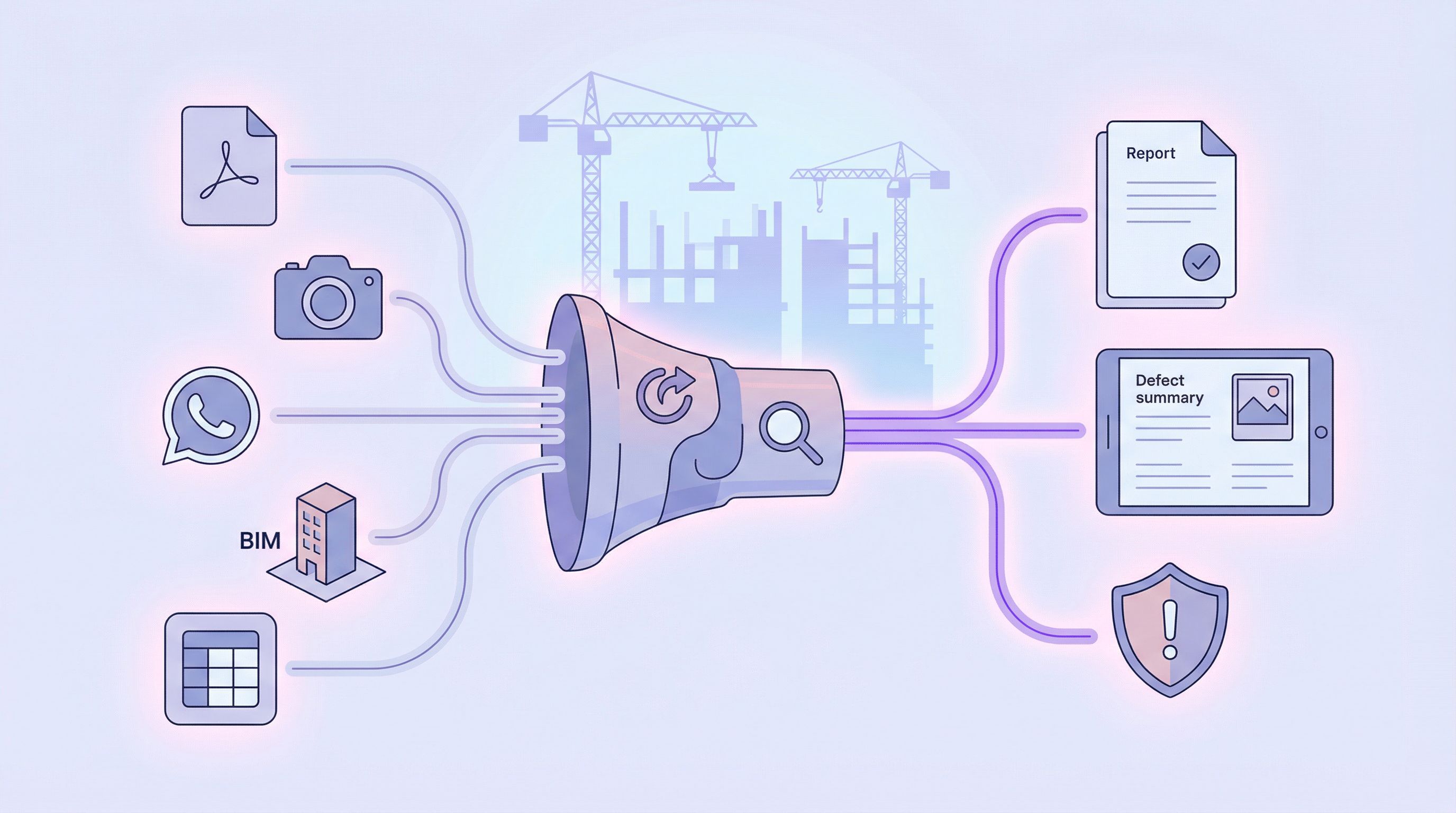
Consider the data types on a typical Singapore construction project:
- BIM files — 3D models containing structural, architectural, and MEP information
- PDF specifications — hundreds of pages of material specs, method statements, and contract documents
- Daily progress reports — often a mix of structured forms and free-text notes
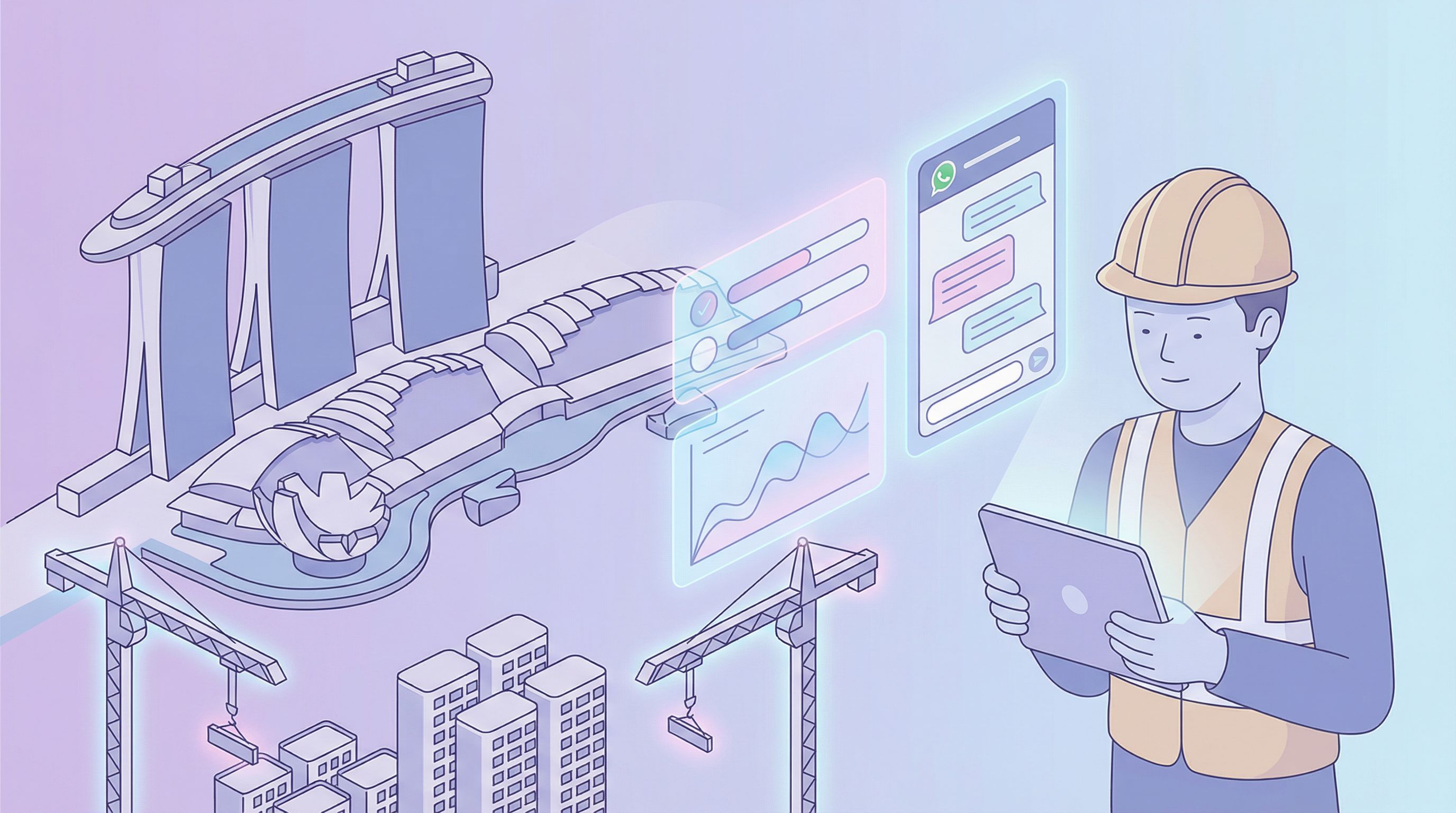
- WhatsApp message archives — the real communication channel on most sites, containing updates, photos, and decisions buried in casual conversation
- Inspection checklists — quality and safety records, sometimes digital, sometimes scanned paper
- Site photos — hundreds per day, with metadata about location, time, and activity
- Spreadsheets — cost tracking, material orders, manpower records
The key challenge is multi-format data. A single question like "Is the rebar inspection for Level 3 complete?" might require cross-referencing a PDF checklist, a WhatsApp photo from the site supervisor, and a progress entry in a spreadsheet. Data preparation must normalise all of these into a format the system can search across.
This stage also involves deduplication (the same photo sent in three WhatsApp groups), cleaning (removing irrelevant messages), and enrichment (tagging photos with location data from BIM coordinates).
Stage 2: Embeddings Generation
Once data is prepared, it must be converted into mathematical representations called embeddings — numerical vectors that capture the meaning of text. This allows the system to find semantically similar content, not just keyword matches.
The critical decision at this stage is chunking strategy — how to break documents into pieces for embedding. This matters more in construction than in most domains.
Consider the abbreviation "L3 RC 50%." To a construction professional in Singapore, this instantly means "Level 3 reinforced concrete work is 50% complete." To a generic text splitter, it's meaningless fragments. Construction-aware chunking must:
- Keep project context intact (don't split a progress entry across chunks)
- Handle domain abbreviations and shorthand
- Preserve relationships between related data (a photo and its caption)
- Balance chunk size — too small loses context ("L3 RC" without "50%" is useless), too large dilutes specific details in a sea of general information
Embedding models must also handle the multilingual reality of Singapore construction sites, where a single WhatsApp thread might contain English technical terms, Mandarin instructions, and Malay shorthand — sometimes within the same message.
Stage 3: Data Retrieval
When someone asks a question, the retrieval stage searches the embedding database for the most relevant chunks of information. This is where construction RAG differs most from generic RAG implementations.
Construction queries have unique characteristics:
- Temporal sensitivity — "What's the status of Block A?" means right now, not last month. The retrieval system must understand time and prioritise recent data.
- Spatial awareness — "Level 3 Zone B" is a specific location. Retrieval must understand the project's spatial hierarchy (Block → Level → Zone → Element).
- Cross-referencing — matching a site photo to a schedule activity, or linking a defect report to the relevant specification clause.
- Implicit context — when a site supervisor asks "any issues today?", the system must know which site, which trades, and what constitutes an "issue" in that project context.
Retrieval accuracy directly determines the quality of the final response. If the wrong documents are retrieved, even the most capable LLM will produce an incorrect or irrelevant answer. In construction, where decisions based on AI responses could affect safety, cost, and schedule, retrieval accuracy is not optional — it's critical.
Stage 4: Response Generation
The final stage is where the LLM synthesises retrieved construction data with its language capabilities to produce a useful response. In construction, this means generating:
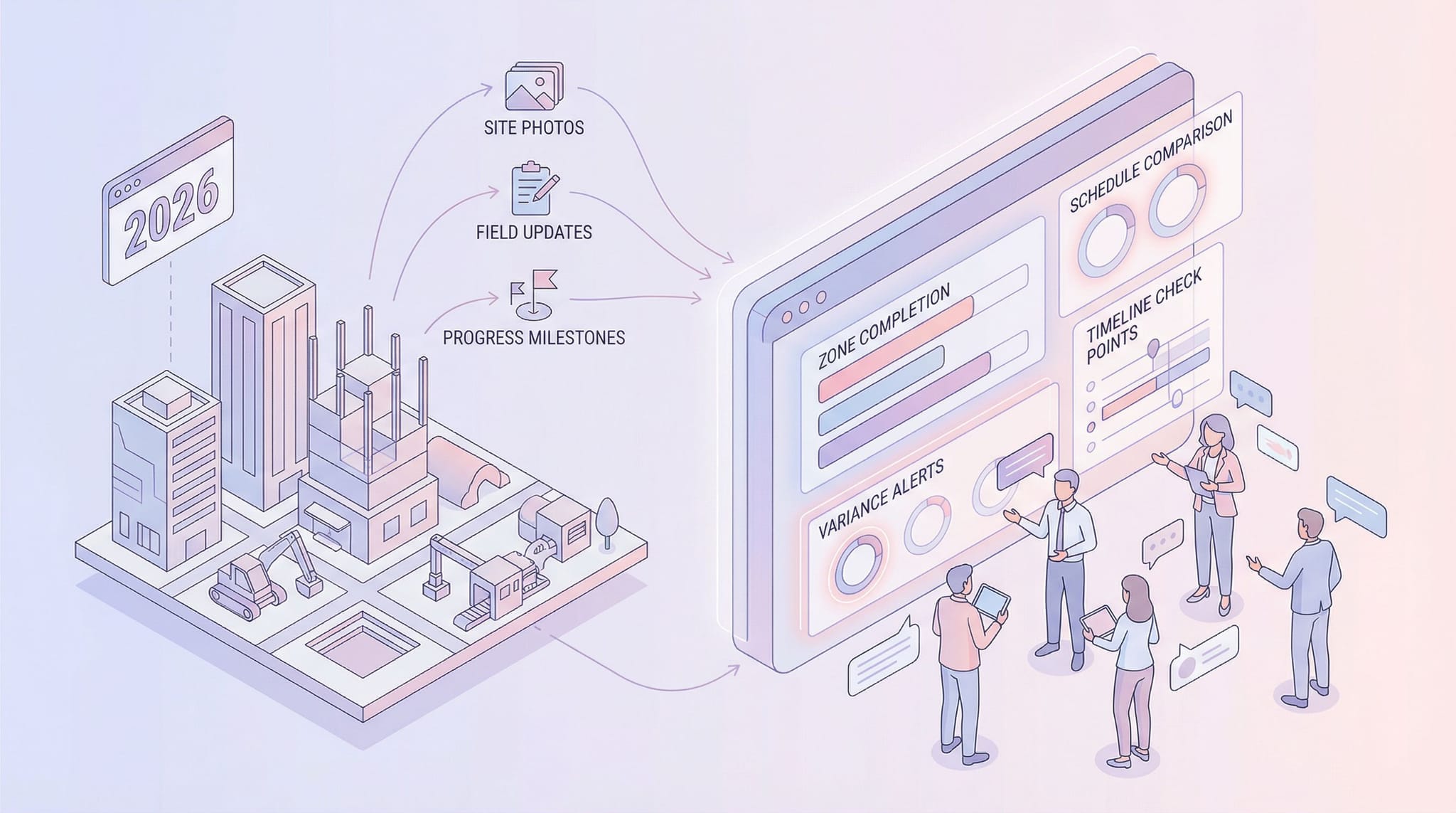
- Structured progress reports — "Block A Level 3: RC works 75% complete, formwork for L4 scheduled to start Monday"
- Defect summaries with evidence — "3 defects identified in Zone B: honeycombing at column C3 (photo attached), water seepage at joint J7, and misaligned formwork at beam B12"
- Safety compliance status — "All permits valid. Excavation permit #EX-234 expires in 2 days — renewal required"
- Schedule variance alerts — "Tiling in Block B is 4 days behind schedule. Current rate suggests 2-week delay to handover unless additional manpower is deployed"
The response is grounded in actual project data, not hallucinated. Every claim can be traced back to the source documents, photos, or messages that informed it. This traceability is what makes RAG trustworthy for construction — an industry where trust in AI outputs must be earned through verifiable accuracy.
Construction-Specific RAG Challenges
Building RAG for construction is harder than building it for, say, customer support or legal document search. Several challenges are unique to the industry:
Multi-format data. Most RAG systems handle text documents well. Construction RAG must simultaneously process photos (with computer vision), PDFs (with OCR and layout understanding), chat messages (with informal language parsing), and spreadsheets (with tabular data extraction). A single query might require evidence from all four.
Multilingual content. Singapore worksites operate in English, Mandarin, Malay, and Tamil — often mixed within a single conversation. "Uncle, 那个 column 的 rebar 还没有 tie 好" is a real message that a construction RAG system must understand. This kind of code-switching is extremely common and requires specialised language processing.
Temporal sensitivity. In construction, time is everything. What was true last Tuesday — "scaffolding erected at Grid 7" — may not be true today. RAG systems must track the temporal dimension of every piece of data and understand that recent information generally supersedes older information, while also being able to answer historical queries ("When was the last safety inspection?").
Domain terminology. Construction has its own language. "Pour" means concrete placement, not liquid motion. "Strike" means removing formwork, not industrial action. "RFI" is a Request for Information, not a radio frequency identifier. Project-specific naming conventions add another layer: what one project calls "Zone A" another calls "Sector 1." A production RAG system must handle all of this without confusion.
From Simple RAG to Production-Ready
Building a RAG prototype that answers simple questions is straightforward. Building a production-ready system that construction teams can trust for daily decisions is another matter entirely.
A basic RAG prototype might use simple semantic search to find relevant documents and pass them to an LLM. This works for demo queries but fails in production for several reasons:
Hybrid retrieval. Pure semantic search misses exact matches (searching for "RFI-0042" semantically might return documents about RFIs in general, not that specific one). Production systems combine semantic search with keyword search to handle both conceptual and exact-match queries.
Reranking. Initial retrieval might return 50 relevant chunks. A reranking model re-evaluates these for relevance to the specific query, ensuring the most pertinent information reaches the LLM. In construction, reranking must account for recency, spatial relevance, and source reliability.
Confidence scoring. Not all queries can be answered with available data. A production system must assess its confidence in each response. "Based on the latest progress report from March 14, Block A Level 3 structural works are 80% complete" is vastly more useful than a response that doesn't indicate its evidence basis.
Graceful uncertainty. The most important feature of a production RAG system is knowing when it doesn't know. When data is insufficient, the system should respond with "I don't have enough recent data to answer this — the last progress update for Block A was 5 days ago" rather than generating a plausible-sounding but fabricated answer. In construction, a hallucinated progress figure could cascade into wrong decisions about resource allocation, schedule, and cost.
Audit trails. Every response must link back to its source documents. When an AI system reports that "waterproofing in Block C basement is complete," a project manager must be able to click through to the inspection report, photos, and sign-off that support that claim. This is not just good practice — for agentic AI systems that take autonomous actions, it's essential for accountability.
Making It Real
RAG is the technology that bridges the gap between powerful AI models and the messy, multi-format, constantly changing reality of construction project data. Without it, LLMs are impressive but impractical for construction. With it, they become genuinely useful tools that can track progress, reduce rework, and give project teams instant access to the information buried in their own data.
The difference between a demo and a production system is significant — but the payoff is equally significant. When construction teams can ask questions in natural language and get accurate, sourced, up-to-date answers in seconds, the entire rhythm of project management changes. Decisions that used to take hours of digging now take seconds.
If you're evaluating how AI can work with your construction data, we'd welcome the conversation. See how production-ready RAG powers real project outcomes in our case studies, or explore how to begin your AI journey at Go Digital.