In 1994, Netscape Navigator shipped and most people shrugged. The internet was a curiosity — slow, ugly, and seemingly irrelevant to serious business. Within five years, it had restructured entire industries. In 2007, the iPhone launched to widespread scepticism from established phone manufacturers. Within a decade, it had destroyed Nokia and created a trillion-dollar app economy.
The pattern is always the same: a new technology emerges, incumbents dismiss it, early adopters experiment, and then — suddenly — the industry flips. We are at that inflection point for AI in construction.
The Pattern of Technological Disruption
Every major industry has been transformed by AI in the last three years. Finance uses it for fraud detection and algorithmic trading. Healthcare deploys it for diagnostic imaging and drug discovery. Logistics companies optimise routes and predict demand. Retail personalises at scale. Legal firms review contracts in minutes instead of weeks.
Construction — a $13 trillion global industry — is next. And the transformation is no longer theoretical. It has already begun.
Why Construction Is the Next Frontier
Construction is not just another industry waiting for AI. It is, by almost every measure, the industry that stands to gain the most from it.
- Massive scale. At $13 trillion globally, construction is one of the world's largest industries. Even marginal efficiency gains translate to billions in value.
- Lowest digitisation. According to McKinsey, construction is the second-least digitised industry in the world, behind only agriculture and hunting. This isn't a weakness — it's an opportunity. There is enormous low-hanging fruit.
- Stagnant productivity. Labour productivity in construction has been essentially flat for 20 years while manufacturing productivity has nearly doubled. The industry is overdue for a step change.
- Data-rich but insight-poor. Construction sites already generate massive amounts of data — photos, messages, reports, sensor readings, schedules. The problem has never been data collection. It's been data utilisation.
- High cost of errors. Rework accounts for 5-20% of contract value on typical projects. Delays cascade through interconnected trades. Safety incidents carry human and financial costs. AI that prevents even a fraction of these errors pays for itself many times over.
- Labour shortages. Across Asia, Europe, and North America, construction faces a chronic shortage of skilled workers. Automation isn't about replacing people — it's about making the people you have dramatically more effective.
From Generative AI to Agentic AI
The AI landscape has evolved rapidly, and understanding this evolution is critical for construction leaders planning their technology strategy.
2022-2023: Generative AI. ChatGPT introduced the world to large language models. These systems could generate text, answer questions, and create content — but only when explicitly prompted. In construction, early experiments focused on using LLMs to draft emails, summarise documents, and answer technical questions. Useful, but limited.
2024-2025: AI Assistants. The next evolution brought AI systems that could work with specific data sources and tools. Upload a document, ask questions about it. Connect to a database, generate reports. These assistants were more capable but still reactive — they waited for human instructions.
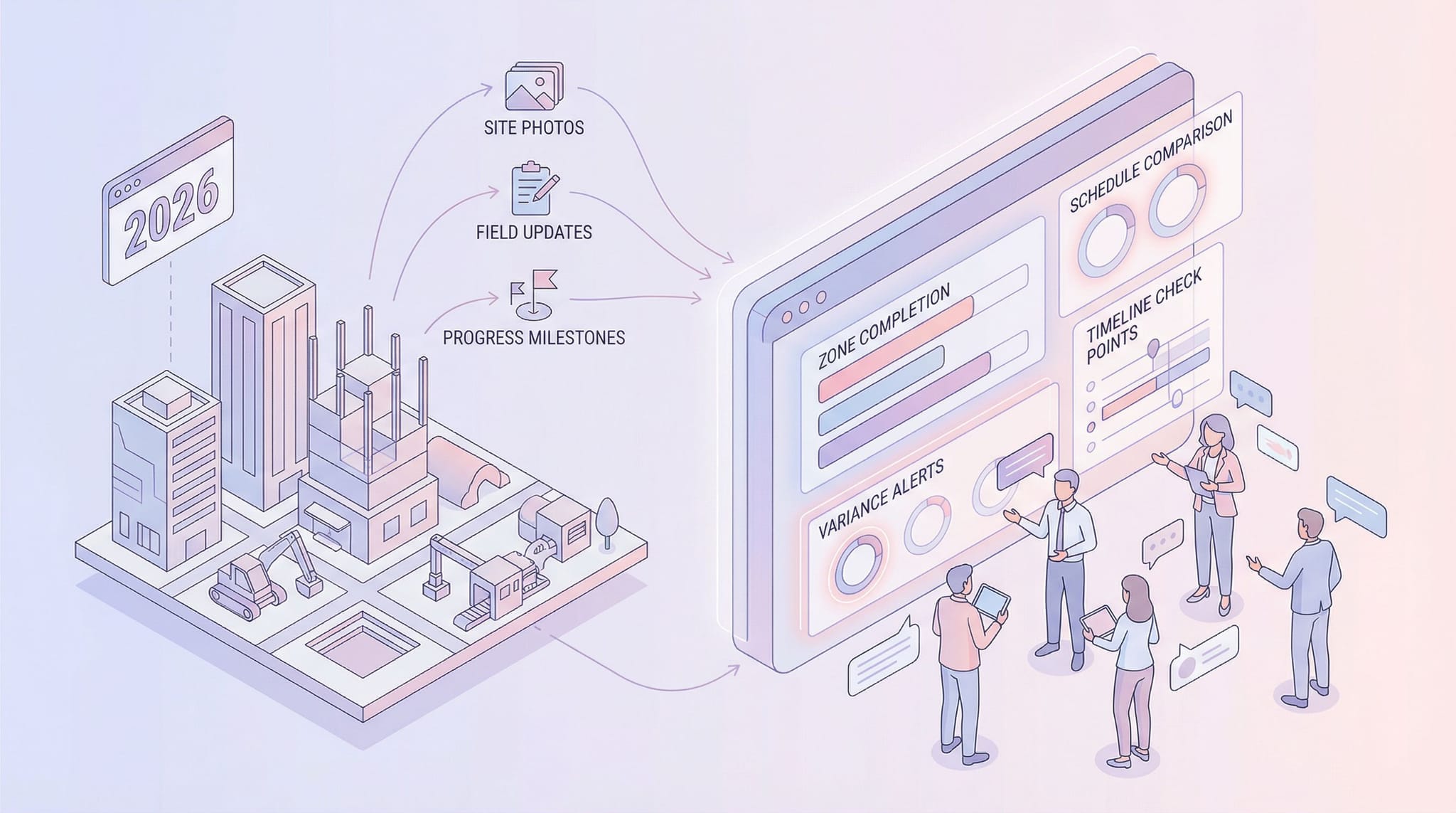
2025-2026: AI Agents. This is where the transformation becomes profound. AI agents don't wait to be asked. They monitor, decide, and act autonomously within defined boundaries. In construction, this means an agent that watches daily site photos as they arrive, analyses progress against the schedule, detects potential issues, generates reports, and alerts supervisors — all without a single human prompt.
The shift from "AI that answers when asked" to "AI that acts when needed" is the difference between a search engine and an autonomous system. It's the difference between a tool and a team member.
What Construction AI Looks Like Today
This isn't a future vision. These capabilities exist and are deployed on real construction projects right now:
Automated progress tracking from site photos. AI analyses daily site photographs to determine construction progress — what's been built, what's changed, what's behind schedule. No manual data entry. No subjective estimates. Objective, photo-verified progress captured automatically.
Real-time safety monitoring. Computer vision systems watch site camera feeds and flag safety violations as they occur — missing PPE, unauthorised zone entry, unsafe lifting practices. Alerts reach safety officers in seconds, not after an incident report is filed the next day.
Defect detection and QA/QC automation. AI identifies construction defects from photos — honeycombing in concrete, alignment issues, incomplete installations — and generates structured defect reports with location data, severity classification, and recommended remediation. Rework that used to be discovered at handover is caught during construction.
WhatsApp-native workflow integration. Rather than forcing construction teams to adopt yet another app, AI meets them where they already work. Site teams send photos and updates via WhatsApp. AI processes these automatically — extracting progress data, flagging issues, updating dashboards. The workflow feels natural because it IS the existing workflow, augmented by AI.
Daily report generation. AI compiles information from multiple sources — photos, messages, weather data, manpower records — into structured daily progress reports. What used to take a site manager 45 minutes of writing at the end of an exhausting day now happens automatically.
The Next Three Years: What's Coming
If current capabilities represent the foundation, the next three years will build the superstructure. Several developments are already visible on the horizon:
Predictive capabilities. Today's AI tells you what happened. Tomorrow's AI will tell you what's about to happen. By analysing patterns across progress data, weather forecasts, supply chain signals, and historical project performance, AI will forecast delays before they materialise. "Based on current progress rate and the weather forecast for next week, concrete works in Block B are likely to fall 3 days behind schedule. Consider mobilising an additional crew by Thursday." This kind of proactive intelligence transforms project management from reactive firefighting to strategic anticipation.
Multimodal integration. Current systems typically process one data type well — photos OR text OR schedules. The next generation will integrate all of them simultaneously. An AI agent will correlate a site photo showing incomplete rebar with the day's WhatsApp messages mentioning a steel delivery delay, cross-reference against the programme, and produce a coherent situation report. This mirrors how an experienced project manager thinks — pulling together information from multiple sources to form a complete picture.
Digital twin integration. AI agents will update BIM models in near real-time based on site observations. As construction progresses, the digital twin evolves to reflect actual conditions rather than design intent. Discrepancies between design and as-built are flagged immediately, not discovered during commissioning. The model becomes a living record of the project.
Cross-project learning. Today, lessons learned from one project rarely transfer effectively to the next. AI changes this fundamentally. Patterns from hundreds of projects — which activities tend to delay, which subcontractor combinations cause coordination issues, which weather conditions affect which trades — become institutional knowledge that improves predictions on every new project. Each project makes the AI smarter for the next one.
Autonomous quality gates. AI systems will increasingly be trusted to clear routine inspections based on photographic and sensor evidence. A system that can verify rebar spacing, concrete cover, and alignment from photos — cross-referenced against specifications — could handle first-pass quality checks, escalating to human inspectors only when anomalies are detected. This doesn't eliminate human judgment; it focuses human attention where it's most needed.
Singapore's Position
Singapore is uniquely positioned to lead the construction AI revolution in Asia-Pacific, and recent policy moves suggest the government recognises this.
The S$30 million investment in a Built Environment AI Centre, announced in Budget 2026, signals serious government commitment to construction AI. This isn't a token gesture — it's a strategic bet on Singapore becoming the regional hub for construction technology innovation.
Several factors make Singapore the ideal proving ground:
- Regulatory framework. The Workplace Safety and Health Act creates clear compliance requirements that AI can help enforce systematically. Strong regulation isn't a barrier to AI adoption — it's a driver, because AI excels at consistent compliance monitoring.
- BCA's digital push. The Building and Construction Authority has been progressively mandating BIM adoption, creating the digital infrastructure that AI needs to operate. Projects already have digital models; AI adds intelligence to them.
- Compact geography. Singapore's small size means innovations can be tested, refined, and scaled across the entire industry faster than in larger countries. A solution proven on one project can reach every major contractor within months, not years.
- Multilingual, multi-cultural workforce. Singapore's construction workforce is one of the most diverse in the world. AI systems that work here — handling multiple languages, cultural communication styles, and regulatory requirements — are inherently built for regional deployment across Southeast Asia.
- Government-industry alignment. Singapore's track record of coordinated government-industry transformation (from port automation to financial technology) provides a proven model for construction AI adoption.
What works in Singapore can scale across APAC — and there is every reason to believe Singapore will be the model that other countries follow.
The Real Question
The question is no longer whether AI will transform construction. The evidence is already conclusive. Companies that adopt thoughtfully are seeing measurable improvements in productivity, quality, and safety. The technology works. The business case is proven.
The real question is whether your organisation will lead or follow.
Leading means starting now — not with a massive transformation programme, but with focused applications that solve real problems. Automated progress tracking on one project. AI-assisted defect detection on another. Building internal capability and confidence through practical experience rather than theoretical planning.
Following means waiting for competitors to prove the value, then scrambling to catch up — paying premium prices for solutions that early adopters shaped to their advantage, and competing for AI talent that early movers have already secured.
The construction industry's transformation by AI is not a prediction. It's a process already underway. The only variable is where your organisation will be positioned when the industry tips — and that tipping point is closer than most people think.
Ready to explore what AI can do for your construction projects today? See real implementations in our case studies, or start a conversation about your digital transformation journey at Go Digital.