What Does "Agentic AI" Actually Mean?
The term "agentic AI" has become one of the most discussed concepts in enterprise technology — but in construction, it carries a very specific and practical meaning.
Agentic AI refers to AI systems that can act autonomously on behalf of a user. Unlike a chatbot that waits for a prompt, or a dashboard that displays static data, an AI agent observes, decides, and executes tasks across multiple steps without requiring constant human input.
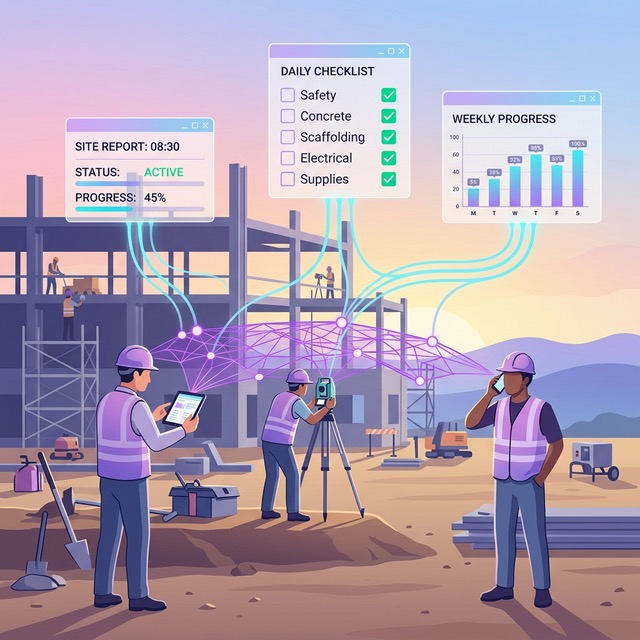
In construction, this distinction matters enormously. Site teams don't have time to sit at a screen prompting a chatbot. They need AI that works in the background — extracting data from photos, structuring WhatsApp messages into logs, and flagging safety issues before anyone has to ask.
This is what makes agentic AI in construction fundamentally different from every previous generation of construction technology.
 How Agentic AI Operates Differently on a Construction Site
Chatbots vs Dashboards vs AI Agents: What's the Difference?
To understand why agentic AI matters for construction, it helps to compare it against what came before.
| Capability | Traditional Software | Chatbot | Agentic AI |
|---|---|---|---|
| Data entry | Manual forms | Prompt-based | Automatic from existing workflows |
| Action trigger | User clicks buttons | User asks questions | AI acts autonomously |
| Multi-step tasks | Requires human at each step | Single Q&A exchanges | Chains actions end-to-end |
| Integrations | Siloed per platform | Limited | Connects across tools (WhatsApp, Excel, CDE) |
| Learning | Static rules | General knowledge | Domain-specific, improves over time |
| Adoption barrier | High (training, onboarding) | Medium (needs prompting) | Low (invisible to end users) |
The key insight is that chatbots still require the user to initiate every interaction. Agentic AI doesn't. It monitors data streams — messages, photos, sensor readings — and takes structured action without being asked.
According to Deloitte's 2024 Engineering & Construction outlook, the construction industry's biggest technology adoption barrier isn't cost — it's workflow disruption. Agentic AI solves this by eliminating the disruption entirely.
Why Construction Needs Agentic AI Specifically
Construction isn't an office environment. The conditions that make other industries suitable for traditional software — stable desks, reliable wifi, dedicated computer time — simply don't exist on most job sites.
Consider what a typical site manager deals with daily:
- Dozens of WhatsApp messages containing progress updates, photos, and requests
- Paper-based checklists that need to be transcribed into digital systems
- Compliance photos sitting in camera rolls that never get logged
- Verbal updates from foremen that aren't captured anywhere
The World Economic Forum found that construction labour productivity has remained flat for decades, despite massive technology investment. The reason? The technology didn't fit the workflow. It added steps instead of removing them.
Agentic AI in construction flips this entirely. Instead of asking workers to change their behaviour, it works with the data they're already generating — messages, photos, voice notes — and turns it into structured, auditable information.
How Wenti Labs Builds Agentic AI for Construction
At Wenti Labs, we've designed our AI agents around three principles that make agentic AI work on real construction sites:
1. Zero-Friction Capture
Workers don't download new apps or learn new systems. They send WhatsApp messages and photos exactly as they already do. Our AI agents process these inputs automatically — see how this works in practice.
2. Autonomous Processing
Once data arrives, our agents don't wait for someone to press a button. They:
- Extract structured fields from unstructured messages
- Classify photos by type (progress, defect, safety)
- Flag anomalies and escalate to the right person
- Generate compliance-ready documentation
This is what separates agentic AI from a simple chatbot integration. The AI isn't answering questions — it's completing workflows.
3. Domain-Specific Intelligence
Our agents are built on RAG (Retrieval-Augmented Generation) pipelines that reference actual construction regulations, project specifications, and historical site data. This means the AI doesn't just process data — it understands construction context. Learn more about how RAG works in enterprise settings.
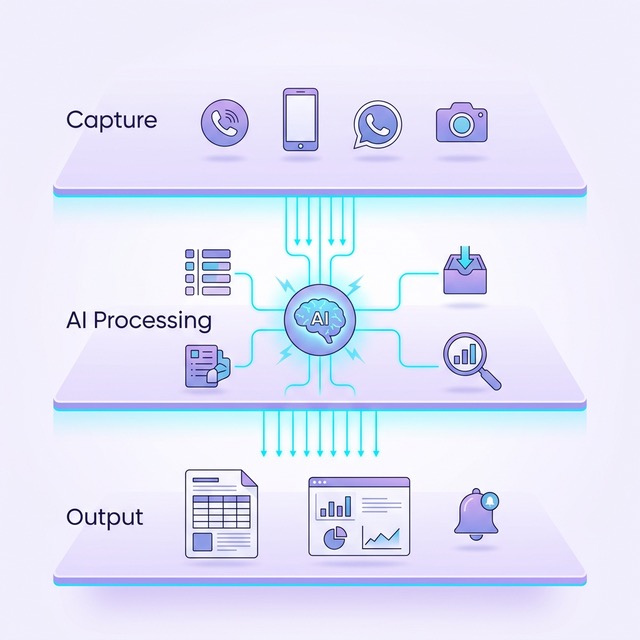 The Three Layers of Agentic AI in Construction
Real-World Impact: What Changes When You Deploy AI Agents
The results from early adopters of agentic AI in construction are measurable and immediate:
- 70% reduction in admin time for site managers consolidating daily reports
- Real-time defect visibility — issues flagged within minutes of photo capture, not days later in a report
- Audit-ready compliance trails generated automatically from everyday communication
- 15+ hours saved per manager per week — time redirected to actual project delivery
These aren't projected benefits. They're results from teams using Wenti Labs' AI agents on active construction sites across Southeast Asia. Read more in our case studies.
The Boston Consulting Group estimates that AI adoption in construction could save the global industry $1.6 trillion annually by 2030. Agentic AI — because of its low adoption barrier and immediate ROI — is the fastest path to realising that potential.
Is Your Team Ready for Agentic AI?
The beauty of agentic AI is that readiness isn't about infrastructure or training. If your team already uses WhatsApp to communicate on site, you're ready.
Ask yourself:
- Are site managers spending hours consolidating updates into reports?
- Do defect photos sit in camera rolls without being logged?
- Is compliance documentation created after the fact instead of in real time?
- Are critical updates buried in group chat threads?
If any of these sound familiar, agentic AI in construction can help — without changing a single thing about how your team works today.
Talk to us about deploying AI agents on your next project, or explore how our approach compares to traditional construction technology.
This post is part of our series on AI agents in construction. See also: How AI Agents on WhatsApp Are Changing Construction Workflows and Construction Safety with AI.